
Table of Contents
TL;DR
The better housing decision is not always the one with the lower monthly payment. Buying can build home equity through principal repayment and appreciation, while renting can build investment wealth when the renter consistently invests the cash not tied up in a purchase. Your local home price, comparable rent, mortgage rate, time horizon and investing habits determine which path creates more net worth.
Renting vs. Buying: A Net Worth Perspective Nobody Talks About
Why the Rent vs. Buy Debate Is Framed Wrong
Ask someone about renting versus buying, and the first comparison is usually monthly rent against the mortgage payment.
That leaves out most of the math.
A mortgage payment does not include the full cost of ownership. Buyers also face closing costs, property taxes, homeowners insurance, maintenance and the opportunity cost of putting a large down payment into one property. Renters do not build home equity, but they can keep upfront cash invested and invest any monthly difference between renting and owning.
The more useful question is not, “Is rent higher than the mortgage?” It is:
Which choice is likely to leave me with greater net worth after the number of years I realistically expect to stay?
A household expecting to move in three years may get a very different answer from a household staying for fifteen years. A buyer in a lower-price market may build equity quickly. A renter in an extremely expensive housing market may be better positioned by investing instead of buying at a high price relative to rent.
The answer comes from the complete balance sheet, not a slogan.
The True Cost of Buying Beyond the Mortgage
Buying a home begins with a down payment. Depending on loan type and financial position, that could range from a low single-digit percentage to 20% or more of the purchase price. A larger down payment reduces the mortgage balance and may reduce borrowing costs, but it also converts accessible cash into home equity.
Closing costs are separate. The Consumer Financial Protection Bureau states that closing costs typically range from 2% to 5% of the home purchase price, excluding the down payment. On a $400,000 home, that is approximately $8,000 to $20,000 spent at purchase.
Then come the ongoing costs:
- Mortgage principal and interest, property taxes, homeowners insurance and any HOA fees.
- Maintenance and replacement costs. Fannie Mae states that a common budgeting guideline is 1% to 4% of the home’s value per year, depending in part on age and condition.
Mortgage principal builds equity. Interest, taxes, insurance, maintenance and purchase costs do not directly increase net worth. They are the price of owning and maintaining the asset.
A homeowner may also benefit from rising home values, but appreciation is not guaranteed. A useful comparison should use a moderate assumption and still leave room for a less favorable outcome.
The True Cost and Opportunity of Renting
Renting has a clear limitation: monthly rent does not purchase home equity. At the end of ten years, the renter does not own part of the property simply because payments were made on time.
But renting avoids several ownership costs. A renter does not normally need a large down payment, does not pay buyer closing costs, does not pay the home’s property taxes directly and is not responsible for major building repairs under an ordinary lease.
That can leave money available for investment.
Suppose buying would require $80,000 for a down payment and $12,000 in closing costs. A renter who invests that $92,000, then consistently invests any monthly cost advantage, is building an asset outside of real estate.
The phrase “renting is throwing money away” ignores this possibility. Rent buys housing. Mortgage interest, property taxes and maintenance also buy housing rather than equity. The wealth difference comes from what remains after all housing costs and what the household does with it.
Scenario A: A High-Cost Market Where Renting Can Win
Consider an illustrative high-price-to-rent market, similar to conditions that can appear in expensive parts of San Francisco or New York City.
Assume a comparable home costs $1,200,000 to buy or $3,800 per month to rent. That produces a price-to-rent ratio of approximately 26.3, calculated by dividing the purchase price by annual rent.
For this example, assume:
| Assumption | Buyer |
| Purchase price | $1,200,000 |
| Down payment, 20% | $240,000 |
| Closing costs, 3% | $36,000 |
| Mortgage amount | $960,000 |
| Mortgage rate and term | 6.5%, 30 years |
| Monthly mortgage principal and interest | About $6,068 |
| Property tax assumption | $1,200/month |
| Insurance assumption | $300/month |
| Maintenance reserve, 1% annually | $1,000/month |
| Total estimated monthly ownership cost | About $8,568 |
The renter pays $3,800 in rent plus an assumed $20 per month for renters insurance, for a monthly housing cost of $3,820. The estimated monthly gap between buying and renting is therefore about $4,748.
Now look at the 10-year net worth result using two assumptions: the home appreciates at 3% annually, and invested money grows at a hypothetical 7% annual return, compounded monthly.
After 10 years, the buyer’s home would be worth approximately $1.61 million, while the remaining mortgage balance would be around $813,851. The resulting home equity would be approximately $798,849.
The renter begins by investing the $276,000 not used for the down payment and closing costs. The renter also invests the estimated $4,748 monthly housing-cost difference. At the assumed 7% return, the investment balance after 10 years would be approximately $1.38 million.
| 10-Year Result | Estimated Asset Value |
| Buyer home equity | $798,849 |
| Renter investment portfolio | $1,376,448 |
Under these assumptions, renting and investing the difference leaves the renter ahead by more than $575,000 before considering selling costs, investment taxes, rent changes or future repair surprises.
This does not prove renting always wins in expensive cities. It shows why buying a home at a very high price relative to rent can make wealth building harder over a ten-year period.
Scenario B: A Lower-Cost Market Where Buying Can Win
Now consider an illustrative lower-price market, similar to conditions that may appear in parts of Memphis or Indianapolis.
Assume a comparable home costs $240,000 to buy or $1,800 per month to rent. The price-to-rent ratio is approximately 11.1, which is far more favorable to the buyer than the earlier example.
Using the same general assumptions:
| Assumption | Buyer |
| Purchase price | $240,000 |
| Down payment, 20% | $48,000 |
| Closing costs, 3% | $7,200 |
| Mortgage amount | $192,000 |
| Mortgage rate and term | 6.5%, 30 years |
| Monthly mortgage principal and interest | About $1,214 |
| Property tax assumption | $240/month |
| Insurance assumption | $150/month |
| Maintenance reserve, 1% annually | $200/month |
| Total estimated monthly ownership cost | About $1,804 |
In this case, renting costs roughly the same as owning each month. Assuming $1,800 rent plus $20 renters insurance, the renter’s monthly cost is slightly higher than the homeowner’s estimated cost.
After 10 years of 3% annual home appreciation, the buyer’s home would be worth approximately $322,540. With a remaining mortgage balance of about $162,770, home equity would reach approximately $159,770. Investing the small monthly buying advantage would bring the buyer’s housing-related asset value to approximately $162,613.
The renter could invest the $55,200 not used for the down payment and closing costs. At a hypothetical 7% annual return, that would grow to approximately $110,933 after 10 years.
| 10-Year Result | Estimated Asset Value |
| Buyer equity plus invested monthly advantage | $162,613 |
| Renter investment portfolio | $110,933 |
Under these assumptions, buying finishes roughly $51,700 ahead after ten years.
The difference is not caused by homeownership being automatically superior. It comes from a purchase price that is reasonable compared with local rent. The buyer receives housing at a similar monthly cost while principal repayment and assumed appreciation build equity.
The Critical Variable: Do You Invest the Difference?
The strongest argument for renting depends on behavior. The renter must actually invest the down payment, closing costs and any monthly savings rather than slowly absorbing that money into ordinary spending.
The same is true for homeowners. Buying only builds wealth effectively when the property is affordable enough to maintain, the mortgage remains manageable and the owner avoids using home equity as a spending account.
There is no need to make unsupported assumptions about what most renters or most homeowners do. Your own behavior is what matters. A disciplined renter can build a powerful investment portfolio. A disciplined homeowner can build equity while also investing outside the home. An undisciplined household can struggle under either option.
Your Personal Break-Even Analysis
Start with four variables: the price of a comparable home, the rent for a similar property, the number of years you expect to stay and the amount you would truly invest under either path.
A quick price-to-rent ratio is useful:
Home Purchase Price ÷ Annual Rent = Price-to-Rent Ratio
A lower ratio can make buying more financially attractive. A higher ratio can make renting and investing more competitive. It is not a final answer because mortgage rates, taxes, insurance, maintenance, closing costs and appreciation still matter.
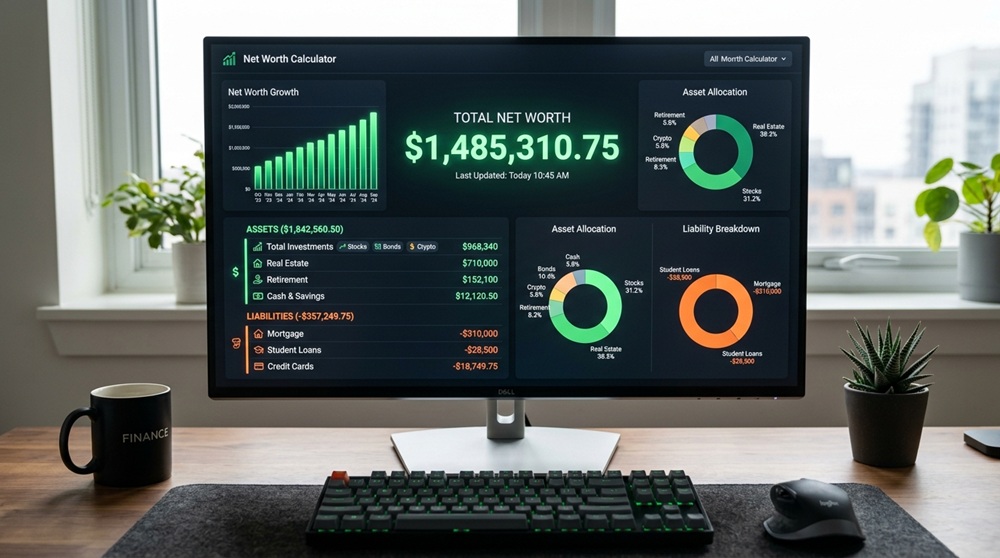
Before forecasting either path, establish your current starting point. Use a calculator to model your own scenario by entering your cash, investments, current property equity, and debts. Then build a simple ten-year comparison using realistic local buying costs, rent, investment contributions and home-value assumptions.
Do not rely on an optimistic home value estimate. Zillow states that its Zestimate is an estimate rather than an appraisal. Use recent comparable sales or professional valuation guidance when a purchase decision is close.
For more practical guidance on assets, liabilities and building a clear financial picture, visit NetlyWorth.
Location and Discipline Determine the Winner
Buying can build substantial net worth when you remain in a reasonably priced home long enough for equity to grow. Renting can build equal or greater wealth when home prices are high relative to rent and the renter consistently invests the money kept outside the purchase.
Run the numbers for your actual city and realistic timeline. Include every ownership cost, not just the mortgage payment. Include the investment opportunity available to a renter, not just the lack of home equity. The right answer is not hidden in the rent-versus-buy debate. It is in the net worth each path can realistically build for you.